Justice Department Orders State-Licensed Medical Marijuana to Schedule III
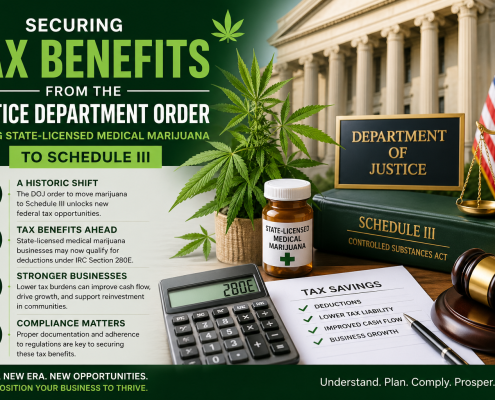
The prime benefits of reclassifying cannabis from a Schedule I substance to a Schedule III substance is that the Federal government would recognize medical benefits of cannabis, make IRC Section 280E inapplicable to licensed cannabis operators.

On December 18, 2025, President Trump signed an Executive Order Increasing Medical Marijuana and Cannabidoil Research . President Trump’s executive order shifts cannabis from Schedule I to Schedule III, easing research, tax restrictions and marking the biggest federal cannabis policy change in decades. Under such order, the Attorney General shall take all necessary steps to complete the rulemaking process related to rescheduling marijuana to Schedule III of the CSA in the most expeditious manner in accordance with Federal law, including 21 U.S.C. 811.

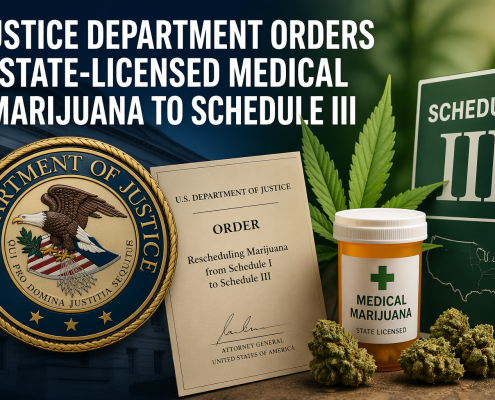
After months of waiting, on April 22, 2026 Acting Attorney General Todd Blanche signed order placing both “FDA-approved drug products containing marijuana, and medicinal marijuana products subject to a qualifying state-issued license” in Schedule III. The action is taken “under his authority to reschedule drugs to carry out the United States’ obligations under the Single Convention on Narcotic Drugs” and follows President Trump’s Executive Order issued December 18, 2025.

According to a press release issued by the Department Of Justice (“DOJ”) on April 23, 2026, “The Department of Justice is delivering on President Trump’s promise to expand Americans’ access to medical treatment options,” said Acting Attorney General Todd Blanche. “This rescheduling action allows for research on the safety and efficacy of this substance, ultimately providing patients with better care and doctors with more reliable information.”

“Under the direction of President Trump and Acting Attorney General Blanche, DEA [Drug Enforcement Administration] is expeditiously moving forward with the administrative hearing process — bringing consistency and oversight to an area that has lacked both,” said DEA Administrator Terry Cole.  “Our men and women in law enforcement remain committed to fighting drug cartels, the fentanyl epidemic, and protecting American lives.”

Separately, the Department announced procedural updates to expedite the ongoing rulemaking process required to fully remove marijuana from Schedule I and place it into Schedule III under the Controlled Substances Act.

Under the Biden administration, a notice of proposed rulemaking was published in the Federal Register on May 21, 2024, followed by a notice of hearing on August 29, 2024. Upon further review, the DEA is withdrawing the prior notice of hearing and terminating those proceedings in order to move more efficiently toward the completion of marijuana’s complete redesignation. This action will accelerate the administrative process, include firm deadlines, and allow DEA to proceed in the most expeditious manner consistent with federal law.

DEA will hold a new administrative hearing beginning June 29, 2026, regarding the proposed rescheduling of marijuana. A new notice of hearing is being published in the Federal Register to govern these proceedings and facilitate a timely resolution of the rulemaking.

Under this framework, medical cannabis is removed from a Schedule I classification — the most restrictive category under the Controlled Substances Act, alongside heroin and LSD — to a Schedule III classification, which encompasses substances with accepted medical use and a lower potential for abuse, such as ketamine and Tylenol with codeine.

In addition, the Centers for Medicare and Medicaid Services, is launching a pilot program enabling certain Medicare-covered seniors to receive free, doctor-recommended CBD products, which must comply with all local and state laws on quality and safety, according to senior White House officials. The products must also come from a legally compliant source and undergo third-party testing for CBD levels and contaminants.

The Growing Trend In Legalizing Cannabis – Current Standings:

Medical marijuana is legal in 39 states and Washington DC

The medical use of cannabis is legal (with a doctor’s recommendation) in 39 states and Washington DC. Currently, the 39 states with medical marijuana legal include Alabama, Alaska, Arizona, Arkansas, California, Colorado, Connecticut, Delaware, Florida, Hawaii, Illinois, Kentucky, Louisiana, Maine, Maryland, Massachusetts, Michigan, Minnesota, Mississippi, Missouri, Montana, Nebraska, Nevada, New Hampshire, New Jersey, New Mexico, New York, North Dakota, Ohio, Oklahoma, Oregon, Pennsylvania, Rhode Island, South Dakota, Utah, Vermont, Virginia, Washington and West Virginia. The medical use of cannabis is also legal in the territories of the Northern Mariana Islands, Guam and Puerto Rico.

Recreational marijuana is legal in 23 states and Washington DC

Twenty-three states and Washington DC, have legalized marijuana for recreational use — no doctor’s letter required — for adults over the age of 21. Those 23 states being Alaska, Arizona, California, Colorado, Connecticut, Delaware, Illinois, Maine, Maryland, Massachusetts, Michigan, Minnesota, Missouri, Montana, Nevada, New Jersey, New Mexico, New York, Ohio, Oregon, Rhode Island, Vermont, Virginia and Washington and the territories of the Northern Mariana Islands and Guam.

Recreational marijuana is legal in 6 tribal nations.

Six Tribal nations have legalized marijuana for recreational use.  Those 6 tribes being the Flandreau Santee Sioux Tribe (South Dakota), Oglala Lakota Sioux Tribe (South Dakota), Suquamish Tribe (Washington state), Squaxin Island Tribe (Washington State), Eastern Band of Cherokee Indians (North Carolina) and St. Regis Mohawk Tribe (New York).

The New Order Could Result In A Tax Regime Similar To What Non-Cannabis Businesses Face.

Generally, businesses can deduct ordinary and necessary business expenses under IRC Section 162. This includes wages, rent, supplies, etc. However, in 1982 Congress added IRC Section 280E. Under IRC Section 280E, taxpayers cannot deduct any amount for a trade or business where the trade or business consists of trafficking in controlled substances…which is currently prohibited by Federal law.

Until the December 18, 2025 Trump executive order reclassification and the April 22, 2026 DOJ order, cannabis was classified in the same category as heroin, ecstasy and LSD under the Controlled Substances Act of 1970. Marijuana, including medical marijuana, is a controlled substance. What this means is that dispensaries and other businesses trafficking in marijuana had to report all of their income and cannot deduct rent, wages, and other expenses, making their marginal tax rate substantially higher than most other businesses.

However, this new reclassification order should effectively exempts companies involved in medical cannabis from IRC Section 280E, allowing them to deduct standard expenses like rent and payroll for the first time.

However, the New Order, DOES NOT Change Reporting Of Cash Payments.

The Bank Secrecy Act of 1970 (“BSA”) requires financial institutions in the United States to assist U.S. government agencies to detect and prevent money laundering. Specifically, the act requires financial institutions to keep records of cash purchases of negotiable instruments, and file reports of cash purchases of these negotiable instruments of more than $10,000 (daily aggregate amount), and to report suspicious activity that might signify money laundering, tax evasion, or other criminal activities. The BSA requires any business receiving one or more related cash payments totaling more than $10,000 to file IRS Form 8300, Report of Cash Payments Over $10,000 Received in a Trade or Business.

The minimum penalty for failing to file EACH Form 8300 is $25,000 if the failure is due to an intentional or willful disregard of the cash reporting requirements. Penalties may also be imposed for causing, or attempting to cause, a trade or business to fail to file a required report; for causing, or attempting to cause, a trade or business to file a required report containing a material omission or misstatement of fact; or for structuring, or attempting to structure, transactions to avoid the reporting requirements. These violations may also be subject to criminal prosecution which, upon conviction, may result in imprisonment of up to 5 years or fines of up to $250,000 for individuals and $500,000 for corporations or both.

Marijuana-related businesses operate in an environment of cash transactions as many banks remain reluctant to do business with many in the marijuana industry. Like any cash-based business the IRS scrutinizes the amount of gross receipts to report and it is harder to prove to the IRS expenses paid in cash. So it is of most importance that the proper facilities and procedures be set up to maintain an adequate system of books and records. However, with this new reclassification cannabis companies’ margins will be larger and major institutional investors will be encouraged to enter the cannabis space, banks may be less reluctant to do business with cannabis-based businesses, and this may convince major exchanges like the NASDAQ to list publicly traded cannabis companies.

Also, the New Order, DOES NOT Legalize Recreational Cannabis.

President Trump stated that he is against legalizing recreational cannabis but classifying it as a Schedule III narcotic would allow expanded research to be conducted into its potential benefits. The Executive Order also fails to address access of cannabis businesses to banking and financial markets even if such businesses exclusively deal with medical cannabis.

The most certain way that cannabis can be legalized and thus be treated like any other lawful business is by Congress enacting legislation.

Tax Saving Opportunities For Cannabis Businesses –

While this order is reflective of the DOJ’s continued dedication to common-sense policies and the prioritization of the safety and well-being of all Americans, keep in mind that the Order only addresses FDA-approved drug products containing marijuana, and medicinal marijuana products subject to a qualifying state-issued license.  There are still hearings to be conducted by the DEA so until this is accomplished the IRS could continue to enforce IRC Section 280E as it has historically done especially since adult-use cannabis would not be covered in the order.

However, the issuance of this order could strengthen the position that cannabis does not “fit the meaning” of a Schedule I substance.  If the premise is that cannabis is no longer considered a Schedule I substance, then one could interpret that it should never have been treated as such under the Controlled Substances Act to begin with.  Given that this new reclassification opens many questions and possibilities into the new tax regime and possibilities for cannabis businesses, tax counsel should be sought on how best to bypass IRC Section 280E and whether it is advisable to amend prior years’ tax returns to reduce outstanding liabilities or seek potential refunds.

How Do You Know Which Cannabis Tax Attorney Is Best For You?

Given that cannabis still remains illegal at a federal level but has been reclassified from a Schedule I substance to a Schedule III substance you need to protect yourself and your marijuana business from all challenges and uncertainty created by the U.S. government so it is best to be proactive and engage an experienced cannabis tax attorney in your area who is highly skilled in the different legal and tax issues that cannabis businesses face.  Let the cannabis tax attorneys of the Law Offices Of Jeffrey B. Kahn, P.C. located in Orange County (Irvine), the Inland Empire (Ontario and Palm Springs) and other California locations protect you and maximize your net profits including the pursuit of filing amended income tax returns which could result in smaller liabilities or produce refunds.  And if you are involved in crypto currency, check out what a bitcoin tax attorney can do for you.


Can Cannabis Help People Improve HDL Cholesterol Levels?

The Center For Disease Control states that high cholesterol usually has no signs or symptoms.  The only way to know whether you have high cholesterol is to get your cholesterol checked.  The cholesterol test, or screening, requires a simple blood draw.

The cholesterol test checks your levels of:

  • Low-density lipoprotein (LDL) or “bad” cholesterol. Having high levels of LDL cholesterol can lead to plaque buildup in your arteries and result in heart disease or stroke.
  • High-density lipoprotein (HDL) or “good” cholesterol. HDL is known as “good” cholesterol because high levels can lower your risk of heart disease and stroke.
  • Triglycerides, a type of fat in your blood that your body uses for energy. The combination of high levels of triglycerides with low HDL cholesterol or high LDL cholesterol levels can increase your risk for heart attack and stroke.
  • Total cholesterol, the total amount of cholesterol in your blood based on your HDL, LDL, and triglycerides numbers.

The Center Of Disease Control states that a good HDL level is greater than or equal to 60 mg/dL.

In a study published on May 27, 2020 in the Journal of Dietary Supplements, researchers found that the daily administration of a commercially available, hemp-derived CBD oil extract is associated with improved HDL cholesterol levels.

Researchers affiliated with The Center for Applied Health Sciences in Ohio and Lindenwood University in Missouri assessed the health effects of a commercially available hemp extract versus placebo in 65 overweight but otherwise healthy participants. Extracts contained 15mg of CBD. Participants consumed either the extract or a placebo daily for a period of six weeks.

The study reported that those taking CBD experienced improved HDL (high-density lipoprotein aka “good”) cholesterol levels as compared to controls. Subjects consuming the extract also acknowledged improvements in sleep and an overall improvement in their quality of life. No significant adverse events were reported.

Researchers concluded, “Overall, these findings suggest that supplementation with this hemp extract at the provided dosage in the men and women studied exhibited improvements in HDL cholesterol, tended to support psychometric measures of perceived sleep quantity and stress response, perceived life pleasure, and is well tolerated in healthy human subjects.”

Developments like this contradict the basis of classification of cannabis under Federal law which makes cannabis illegal.

The Anti-Federal U.S. Climate

The Federal Controlled Substances Act (“CSA”) 21 U.S.C. § 812 classifies marijuana as a Schedule 1 substance with a high potential for abuse, no currently accepted medical use in treatment, and lack of accepted safety for use under medical supervision. Although you can still face federal criminal charges for using, growing, or selling weed in a manner that is completely lawful under California law, the federal authorities in the past have pulled back from targeting individuals and businesses engaged in medical marijuana activities. This pull back came from Department of Justice (“DOJ”) Safe Harbor Guidelines issued in 2013 under what is known as the “Cole Memo”.

The Cole Memo included eight factors for prosecutors to look at in deciding whether to charge a medical marijuana business with violating the Federal law:

  • Does the business allow minors to gain access to marijuana?
  • Is revenue from the business funding criminal activities or gangs?
  • Is the marijuana being diverted to other states?
  • Is the legitimate medical marijuana business being used as a cover or pretext for the traffic of other drugs or other criminal enterprises?
  • Are violence or firearms being used in the cultivation and distribution of marijuana?
  • Does the business contribute to drugged driving or other adverse public health issues?
  • Is marijuana being grown on public lands or in a way that jeopardizes the environment or public safety?
  • Is marijuana being used on federal property?

Since 2013, these guidelines provided a level of certainty to the marijuana industry as to what point could you be crossing the line with the Federal government.  But on January 4, 2018, then Attorney General Jeff Sessions revoked the Cole Memo.  Now U.S. Attorneys in the local offices throughout the country retain broad prosecutorial discretion as to whether to prosecute cannabis businesses under federal law even though the state that these businesses operate in have legalized some form of marijuana.

Joyce-Blumenauer Amendment (previously referred to as the Rohrabacher-Farr Amendment)

Medical marijuana is legal in 33 states.

The medical use of cannabis is legal (with a doctor’s recommendation) in 33 states and Washington DC. Those 33 states being Alaska, Arizona, Arkansas, California, Colorado, Connecticut, Delaware, Florida, Hawaii, Illinois, Maine, Louisiana, Maryland, Massachusetts, Michigan, Minnesota, Missouri, Montana, Nevada, New Hampshire, New Jersey, New Mexico, New York, North Dakota, Ohio, Oklahoma, Oregon, Pennsylvania, Rhode Island, Utah, Vermont, Washington and West Virginia. The medical use of cannabis is also legal in the territories of the Northern Mariana Islands, Guam and Puerto Rico.

Recreational marijuana is legal in 11 states.

Eleven states and Washington DC, have legalized marijuana for recreational use — no doctor’s letter required — for adults over the age of 21. Those eleven states being Alaska, California, Colorado, Illinois, Maine, Massachusetts, Michigan, Nevada, Oregon, Vermont and Washington and the territory of Guam.

Building on the DOJ’s issuance of the Cole Memo, in 2014 the House passed an amendment to the yearly federal appropriations bill that effectively shields medical marijuana businesses from federal prosecution. Proposed by Representatives Rohrabacher and Farr, the amendment forbids federal agencies to spend money on investigating and prosecuting medical marijuana-related activities in states where such activities are legal.

The amendment states that:

“None of the funds made available under this Act to the Department of Justice may be used, with respect to any of the States of Alabama, Alaska, Arizona, Arkansas, California, Colorado, Connecticut, Delaware, Florida, Georgia, Hawaii, Illinois, Indiana, Iowa, Kentucky, Louisiana, Maine, Maryland, Massachusetts, Michigan, Minnesota, Mississippi, Missouri, Montana, Nevada, New Hampshire, New Jersey, New Mexico, New York, North Carolina, North Dakota, Ohio, Oklahoma, Oregon, Pennsylvania, Rhode Island, South Carolina, Tennessee, Texas, Utah, Vermont, Virginia, Washington, West Virginia, Wisconsin, and Wyoming, or with respect to the District of Columbia, Guam, or Puerto Rico, to prevent any of them from implementing their own laws that authorize the use, distribution, possession, or cultivation of medical marijuana.”

This action by the House is not impacted by former Attorney General Sessions’ change of position with the DOJ. However, unless this amendment gets included in each succeeding federal appropriations bill, the protection from Federal prosecution of medical marijuana businesses will no longer be in place.

Fortunately for medical marijuana businesses in the last budget extension approved by Congress, this amendment was included. This means that the DOJ is precluded from spending funds to circumvent any of the foregoing states from implementing their medical cannabis laws.

Clearly, to avail yourself of the protections of the amendment, you must be on the medical cannabis side and you must be in complete compliance with your State’s medical cannabis laws and regulations. You may not be covered under the amendment if you are involved in the recreational cannabis side even if legal in the State you are operating.

What Should You Do?

Given the illegal status of cannabis under Federal law you need to protect yourself and your marijuana business from all challenges created by the U.S. government.  Although cannabis is legal in California, that is not enough to protect you. Be proactive and engage an experienced Cannabis Tax Attorney in your area. Let the tax attorneys of the Law Offices Of Jeffrey B. Kahn, P.C. located in Orange County, Inland Empire (Ontario and Palm Springs) and other California locations protect you and maximize your net profits.  And if you are involved in crypto currency, check out what a bitcoin tax attorney can do for you.