
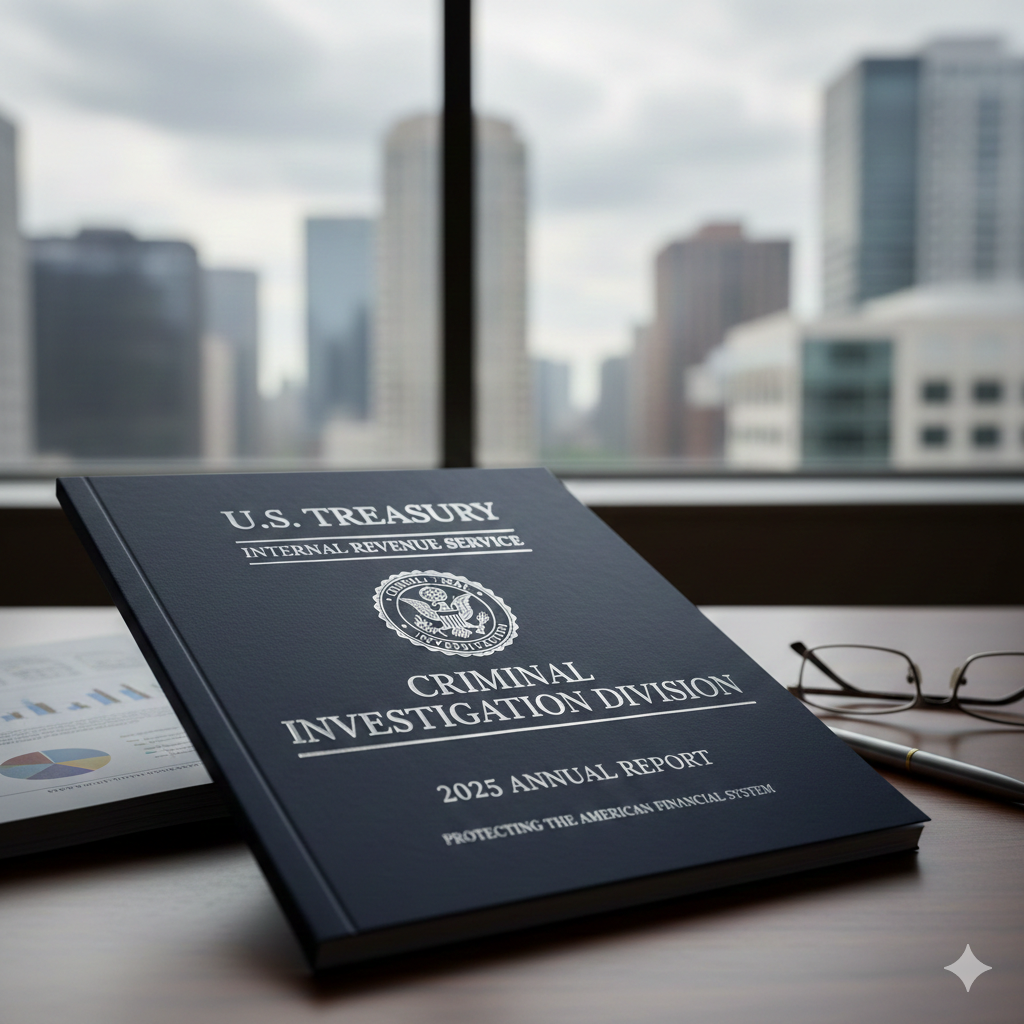
IRS Criminal Investigation Division Releases Its 2025 Annual Report
The IRS released the Criminal Investigation Division’s (CI) annual report, highlighting significant successes and criminal enforcement actions taken in fiscal year ending September 30, 2025. The IRS noted that a key achievement was the identification of over $10.5 billion in tax fraud and other financial crimes.
In issuing this report IRS Chief Of IRS Criminal Investigation Guy Ficco stated: “The cases the IRS-CI team investigated over the past fiscal year touch multiple continents and require cooperation with partners around the globe. This is why IRS-CI continues to cement itself as the preeminent law enforcement agency investigating financial crimes on a global scale.”
According to the report, CI initiated 2,043 cases in fiscal year 2025, applying approximately 63% of its time to tax related investigations. CI is the only federal law enforcement agency with jurisdiction over federal tax crimes achieving a conviction rate of 89% in fiscal year 2025. IRS-CI is the only U.S. federal law enforcement agency that focuses 100% on financial investigations.
IRS Criminal Investigation Division Expands Its International Network
The report states that in the last fiscal year IRS-CI built upon its existing network of U.S. field offices and international attachés to combat financial crimes across the globe through the agency’s alliance with the Joint Chiefs of Global Tax Enforcement (J5) and public-private partnerships with financial institutions and the Fin-Tech industry to deter and identify criminal activity.
IRS-CI dedicates itself to “… follow the money. We’ve been doing it for more than 100 years, and we’ve followed criminals into the dark web and now into the metaverse. Tax and other financial crimes know no borders. If you violate the law and end up in the crosshairs of an IRS-CI special agent, you are likely going to jail.”
Case Examples Included In The Annual Report
The Los Angeles Field Office investigated Casie Hynes for tax-related crimes. She was sentenced to 60 months in federal prison for wire fraud and presenting false claims to the United States. She was also ordered to pay $2.37 million in restitution. She exploited COVID-19 relief programs and pandemic tax credits submitting over 80 fraudulent loan applications through the Paycheck Protection Program (PPP) and Economic Injury Disaster Loan (EIDL) program, seeking more than $3.1 million in relief funds. She fabricated the number of employees, payroll amounts, and supporting tax and bank records, and she used the personal information and signature of others without authorization. Through this scheme, she successfully obtained approximately $2.25 million in fraudulent loan proceeds. In addition, she submitted a dozen fraudulent tax filings claiming nearly $1.3 million in pandemic related tax credits, including the Employee Retention Credit and Paid Sick And Family Leave Credits.
The Charlotte Field Office investigated Victor Smith CPA and William Tomasello CPA who promoted and sold tax deductions to wealthy clients in illegal syndicated conservation easement tax shelters. Smith with his associates sold approximately $14 million and false tax deductions to their clients, causing a tax loss to the IRS of about $4.8 million. Smith himself earned $491,400 in commissions. Tomasello also promoted and sold units to his wealthy clients causing a tax loss of about $2.3 million. He earned $525,072 in commissions. The defendants knew that contrary to law, these tax shelters, lacked economic substance, and that their wealthy clients participated in the sham investments only to obtain a tax deduction. The defendants also knowingly instructed and caused their clients to falsely backdate documents, like subscription agreements, and checks related to the illegal tax shelters. Smith and Tomasello were each sentenced to 20 months in prison for their role in the scheme.
The Special Agent’s Role In The IRS Criminal Investigation Division
An IRS Special Agent works for CI. Special Agents are duly sworn law enforcement officers who are trained to “follow the money”. They investigate potential criminal violations of the Internal Revenue Code, and related financial crimes. Unless they are working undercover they will identify themselves with credentials which include a gold badge. The same gold badge appears on their business cards. Generally, IRS Special Agents travel in pairs if they are going to interview someone. One to conduct the interview, and the other to take notes, and act as a witness if necessary.
If you are contacted by an IRS Special Agent it is because he or she is conducting a CRIMINAL investigation. It is possible that the Special Agent is only interested in you as a witness against the target of the IRS investigation. However, it is a bad idea to speak to Special Agent without a criminal tax attorney present. IRS Special Agents are highly trained financial investigators. If you are the target or subject of an IRS criminal investigation you are not going to talk your way out of it, by “cooperating”; instead you may be giving the IRS more evidence to use against you.
Even if the IRS Special Agent tells you that you are only a witness you should still consult with an experienced criminal tax attorney BEFORE speaking with an IRS agent. If you make misstatements that you think put you in a better light you could change your role from a witness into a target. The best tactic is to simply tell the Special Agent that you are uncomfortable talking to him until you have had a chance to speak with your attorney. Then ask him for his business card. In this way your tax attorney can contact the Special Agent directly, and determine the best course of action.
There are a number of statutes in the Internal Revenue Code that authorize the federal government to prosecute individuals, including those dealing with tax evasion, fraud and false statements, failure to file returns, failure to pay tax, etc. Some, like the tax evasion statute, are worded in particularly broad terms and may ensnare the unwary or careless taxpayers.
If CI recommends prosecution, it will give its evidence to the Justice Department to decide the special charges. Individuals are typically charged with one or more of three crimes: tax evasion, filing a false return, or not filing a tax return. All of which are tax fraud.
Two Special Programs Run By CI
With the avalanche of billions of data flowing to IRS, CI has been running two special programs: the International Tax Enforcement Group (ITEG), and the Nationally Coordinated Investigations Unit (NCIU). Both focus on increasing the rate of taxpayer compliance with income reporting requirements contained in the Internal Revenue Code – particularly those pertaining to the disclosure of foreign financial accounts, reporting of virtual currency transactions, and reporting transactions involving cannabis.
What Should You Do?
Very quickly a criminal investigation can turn to the worst for a targeted taxpayer so you should promptly seek tax counsel who can act proactively before the IRS does. Let the tax attorneys at the Law Offices Of Jeffrey B. Kahn, P.C. located in Orange County (Irvine), Los Angeles and other locations within California protect you from excessive fines and possible jail time. Also, if you are involved in cannabis, check out how a cannabis tax attorney can help you. And if you are involved in crypto currency, check out what a bitcoin tax attorney can do for you.
 Follow
 Follow
