

Do You Have A Cannabis Business Drowning In IRS Debt?

Rescheduling Of Cannabis Opens Relief For Cannabis Businesses To Settle IRS Tax Debt Through An Offer In Compromise.

President Trump’s December 18, 2025 Executive Order to remove cannabis from a Schedule I classification to a Schedule III classification

President Trump’s execution on December 18, 2025 of an Executive Order Increasing Medical Marijuana and Cannabidoil Research to remove cannabis from a Schedule I classification to a Schedule III classification has created much confusion with some arguing that he does not have such authority to reschedule and others stating that this Order is merely a directive for the Executive Branch to implement changes to accomplish this rescheduling.

The issuance of this Executive Order however should result in cannabis businesses with IRS debt to pursue discounted settlements under the IRS Offer In Compromise program.

How Does This Executive Order Make A Difference?

The IRS generally approves an Offer In Compromise when the amount you offer represents the most IRS can expect to collect within a reasonable period of time.  This standard is defined as “reasonable collection potential” but if you are a cannabis business with outstanding IRS liabilities, the IRS had followed a more restrictive approach.

IRC Section 280E disallows any deduction or credit of amounts paid or incurred in carrying on any trade or business of trafficking in controlled substances under Schedule I or Schedule II. The Internal Revenue Manual requires expenses that would be disallowed by IRC Section 280E to be disregarded when the IRS is calculating a taxpayer’s reasonable collection potential for an Offer In Compromise.  Cannabis businesses have been subject to IRC Section 280E as a Schedule I substance.

Such a concept on December 16, 2025 was affirmed by the U.S. Tax Court when it issued its opinion in Mission Organic Center Inc. v. Commissioner Of Internal Revenue, 165 T.C. 13 (2025), sustaining the IRS’ denial of this cannabis dispensary to pursue an Offer In Compromise.  The taxpayer in calculating the amount of its offer reduced its future income by operating expenses that were ordinary and necessary to conduct business but was not deductible for tax purposes under IRC Section 280E. The IRS Revenue Officer disregarded such expenses when calculating the taxpayer’s reasonable collection potential.

So, for example, rent expense which is an ordinary and necessary expense which of course if not paid would result in the landlord evicting the taxpayer and thus terminating the business.  It is crazy that IRS would disregard such an expense for purposes of determining reasonable collection potential on the basis that the taxpayer is not allowed to deduct this rent expense in arriving at its taxable income.  Interestingly, the IRS will allow taxpayers submitting an Offer In Compromise to reduce their future income by such applicable obligations like alimony, child support, student loan payments, secure loan obligations, and certain limited personal living expenses, even though all the foregoing is not deductible for income tax purposes.

What Is An Offer In Compromise?

An Offer In Compromise is an agreement between a taxpayer and the IRS to settle a tax debt for less than the full amount owed. Generally, it may be an option for taxpayers who can’t pay their full tax debt, or if doing so would create a financial hardship. The IRS considers the taxpayer’s overall financial circumstances when considering an Offer In Compromise in an effort to administratively resolve the amount due.

Taxpayers who want to avail themselves of the IRS Offer In Compromise program file a formal application, in which they propose to pay less than their total obligation amount (taxes, interest and any associated penalties). That much is straightforward. But as another adage goes: “the devil is in the details,” and that is where many taxpayers head in the wrong direction, and make an already challenging and stressful financial situation exponentially worse.

It All Comes Down To Reducing Your Past IRS Debt

There is a school of thought that the issuance of this Executive Order could be construed as an affirmation that cannabis does not “fit the meaning” of a Schedule I substance; and therefore, cannabis should never have been treated as such under the Controlled Substances Act to begin with.  This theory has yet to be tested in the Courts but given the effect of the Executive Order that supports the viability of cannabis businesses to pursue an Offer In Compromise to settle past IRS debt, we have been recommending cannabis businesses pursue the Offer In Compromise approach.  Another advantage of an Offer In Compromise over amending past year tax returns is that while the Offer In Compromise is being considered by IRS (or any denial is being appealed), the IRS cannot enforce collection action.  That puts a pause on levies, garnishments, and tax liens for months if not years while this is being sorted out.

Here are the four biggest myths on pursuing an Offer In Compromise –

  1. IRS Offer In Compromise Myth: Taxpayers only need to petition the Federal government to take advantage of the program.

The Facts: Many States have Offer In Compromise programs, and each has its own qualifying standards. Taxpayers who owe money to both the IRS and their respective State tax agency must coordinate the filings in order to facilitate a mutually acceptable resolution. Just dealing with the IRS is not enough, and the IRS is under no obligation (and will not) reach out to their State-level counterparts. The onus to do this is completely on each taxpayer.

  1. IRS Offer In Compromise Myth: Filling out the proper forms is time consuming, but does not require expertise.

The Facts: The vast majority of taxpayers do not have requisite knowledge of the IRS collection process for their petition to be successful, regardless of how much time they allocate to their application. While the lists of common errors is long, among the most frequent are: overstating assets and income (and therefore offering the IRS too much); failing to submit the proper application fee and a deposit for the amount offered; and failing to include proper financial disclosure. And if you are still not convinced: the Federal government’s own figures show that 75% of applications are returned due to forms being filled out incorrectly, and of the 25% that are processed, approximately 50% are rejected.

  1. IRS Offer In Compromise Myth: Third-party firms and consultants can help you settle your debt and enjoy a “big discount.”

The Facts: This is false advertising at its worst, since the consequences here can be life-altering. These firms and consultants have no idea what your tax situation is like, and therefore cannot even promise that the IRS will accept your petition, let alone allow you to enjoy a “big discount.” Only a qualified and experienced professional who has analyzed your specific financial details, and who knows the IRS rules and guidelines inside and out (including material that is not easily available to the public — or comprehensible even when it is) can determine your eligibility for an Offer In Compromise.

  1. IRS Offer In Compromise Myth: If you owe money to the IRS, then you submit an application right away to stop collection action or interest while your case is being reviewed.

The Facts: Before the IRS will even consider your application, they will check to see where you are current with all filing requirements. If anything is overdue, or if you are in an open bankruptcy proceeding, then your application will be returned to you.

The Bottom Line

The IRS Offer In Compromise program has the potential to be substantially beneficial for qualifying taxpayers who (and this is the most critical part) complete and submit their application properly, completely and effectively. If your cannabis business is facing shut-down by the IRS for outstanding IRS debt, the submission of an Offer In Compromise should put a stop on such action.  This relief allows for the business to continue to operate and negotiations with the IRS to commence.  The IRS assesses applications on a case-by-case basis, and the more boxes you check, the more likely you are to be granted financial relief. Conversely, if you get trapped by any of the myths above — or dozens of others that endure — not only will your application be rejected and returned, but your debt will continue piling up by the day.

What Should You Do?

The tax attorneys at the Law Offices Of Jeffrey B. Kahn, P.C. located in Orange County (Irvine), Los Angeles and elsewhere in California are highly skilled in handling tax matters and can effectively represent at all levels with the IRS and State Tax Agencies including criminal tax investigations and attempted prosecutions, undisclosed foreign bank accounts and other foreign assets, and unreported foreign income. We understand the cannabis industry and having a cannabis tax attorney on your side can make the difference in getting the tax relief you deserve.  Also, if you are involved in crypto currency, check out what a Bitcoin Tax Attorney can do for you.

IRS Criminal Investigation Division Releases Its 2025 Annual Report

The IRS released the Criminal Investigation Division’s (CI) annual report, highlighting significant successes and criminal enforcement actions taken in fiscal year ending September 30, 2025.  The IRS noted that a key achievement was the identification of over $10.5 billion in tax fraud and other financial crimes.

In issuing this report IRS Chief Of IRS Criminal Investigation Guy Ficco stated:  “The cases the IRS-CI team investigated over the past fiscal year touch multiple continents and require cooperation with partners around the globe. This is why IRS-CI continues to cement itself as the preeminent law enforcement agency investigating financial crimes on a global scale.”

According to the report, CI initiated 2,043 cases in fiscal year 2025, applying approximately 63% of its time to tax related investigations. CI is the only federal law enforcement agency with jurisdiction over federal tax crimes achieving a conviction rate of 89% in fiscal year 2025.   IRS-CI is the only U.S. federal law enforcement agency that focuses 100% on financial investigations.

IRS Criminal Investigation Division Expands Its International Network

The report states that in the last fiscal year IRS-CI built upon its existing network of U.S. field offices and international attachés to combat financial crimes across the globe through the agency’s alliance with the Joint Chiefs of Global Tax Enforcement (J5) and public-private partnerships with financial institutions and the Fin-Tech industry to deter and identify criminal activity.

IRS-CI dedicates itself to “… follow the money. We’ve been doing it for more than 100 years, and we’ve followed criminals into the dark web and now into the metaverse. Tax and other financial crimes know no borders. If you violate the law and end up in the crosshairs of an IRS-CI special agent, you are likely going to jail.”

Case Examples Included In The Annual Report

The Los Angeles Field Office investigated Casie Hynes for tax-related crimes. She was sentenced to 60 months in federal prison for wire fraud and presenting false claims to the United States. She was also ordered to pay $2.37 million in restitution.  She exploited COVID-19 relief programs and pandemic tax credits submitting over 80 fraudulent loan applications through the Paycheck Protection Program (PPP) and Economic Injury Disaster Loan (EIDL) program, seeking more than $3.1 million in relief funds.  She fabricated the number of employees, payroll amounts, and supporting tax and bank records, and she used the personal information and signature of others without authorization. Through this scheme, she successfully obtained approximately $2.25 million in fraudulent loan proceeds. In addition, she submitted a dozen fraudulent tax filings claiming nearly $1.3 million in pandemic related tax credits, including the Employee Retention Credit and Paid Sick And Family Leave Credits.

The Charlotte Field Office investigated Victor Smith CPA and William Tomasello CPA who promoted and sold tax deductions to wealthy clients in illegal syndicated conservation easement tax shelters. Smith with his associates sold approximately $14 million and false tax deductions to their clients, causing a tax loss to the IRS of about $4.8 million. Smith himself earned $491,400 in commissions. Tomasello also promoted and sold units to his wealthy clients causing a tax loss of about $2.3 million. He earned $525,072 in commissions.  The defendants knew that contrary to law, these tax shelters, lacked economic substance, and that their wealthy clients participated in the sham investments only to obtain a tax deduction. The defendants also knowingly instructed and caused their clients to falsely backdate documents, like subscription agreements, and checks related to the illegal tax shelters. Smith and Tomasello were each sentenced to 20 months in prison for their role in the scheme.

The Special Agent’s Role In The IRS Criminal Investigation Division

An IRS Special Agent works for CI. Special Agents are duly sworn law enforcement officers who are trained to “follow the money”. They investigate potential criminal violations of the Internal Revenue Code, and related financial crimes. Unless they are working undercover they will identify themselves with credentials which include a gold badge. The same gold badge appears on their business cards. Generally, IRS Special Agents travel in pairs if they are going to interview someone. One to conduct the interview, and the other to take notes, and act as a witness if necessary.

If you are contacted by an IRS Special Agent it is because he or she is conducting a CRIMINAL investigation. It is possible that the Special Agent is only interested in you as a witness against the target of the IRS investigation. However, it is a bad idea to speak to Special Agent without a criminal tax attorney present. IRS Special Agents are highly trained financial investigators. If you are the target or subject of an IRS criminal investigation you are not going to talk your way out of it, by “cooperating”; instead you may be giving the IRS more evidence to use against you.

Even if the IRS Special Agent tells you that you are only a witness you should still consult with an experienced criminal tax attorney BEFORE speaking with an IRS agent. If you make misstatements that you think put you in a better light you could change your role from a witness into a target. The best tactic is to simply tell the Special Agent that you are uncomfortable talking to him until you have had a chance to speak with your attorney. Then ask him for his business card. In this way your tax attorney can contact the Special Agent directly, and determine the best course of action.

There are a number of statutes in the Internal Revenue Code that authorize the federal government to prosecute individuals, including those dealing with tax evasion, fraud and false statements, failure to file returns, failure to pay tax, etc. Some, like the tax evasion statute, are worded in particularly broad terms and may ensnare the unwary or careless taxpayers.

If CI recommends prosecution, it will give its evidence to the Justice Department to decide the special charges. Individuals are typically charged with one or more of three crimes: tax evasion, filing a false return, or not filing a tax return. All of which are tax fraud.

Two Special Programs Run By CI

With the avalanche of billions of data flowing to IRS, CI has been running two special programs: the International Tax Enforcement Group (ITEG), and the Nationally Coordinated Investigations Unit (NCIU). Both focus on increasing the rate of taxpayer compliance with income reporting requirements contained in the Internal Revenue Code – particularly those pertaining to the disclosure of foreign financial accounts, reporting of virtual currency transactions, and reporting transactions involving cannabis.

What Should You Do?

Very quickly a criminal investigation can turn to the worst for a targeted taxpayer so you should promptly seek tax counsel who can act proactively before the IRS does. Let the tax attorneys at the Law Offices Of Jeffrey B. Kahn, P.C. located in Orange County (Irvine), Los Angeles and other locations within California protect you from excessive fines and possible jail time. Also, if you are involved in cannabis, check out how a cannabis tax attorney can help you. And if you are involved in crypto currency, check out what a bitcoin tax attorney can do for you.

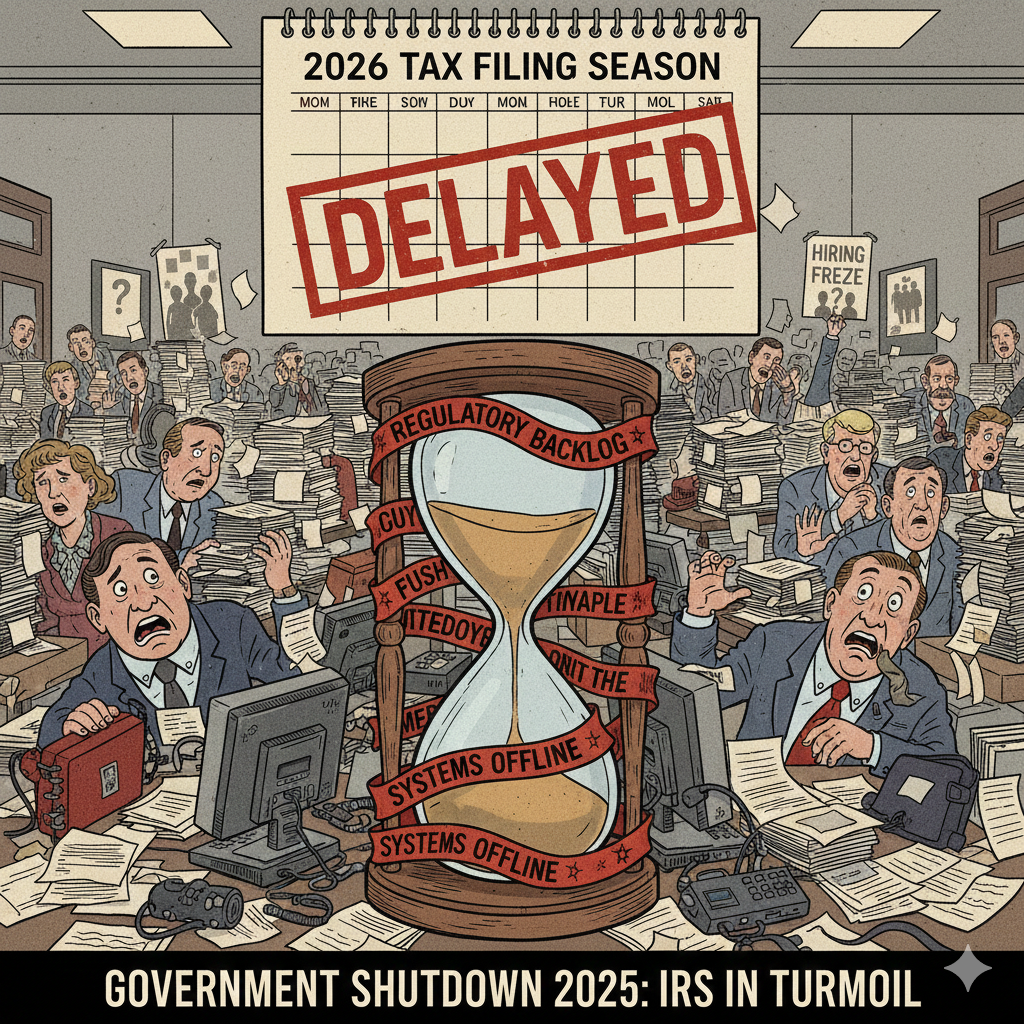
How may the 2025 government shutdown impact IRS preparation for the 2026 filing season?

Former IRS Commissioner Danny Werfel expressed concern over events since his resignation in January 2025 that he believes will have an adverse impact on IRS’ ability to handle operations for the 2026 filing season.

Those events comprise of –

  • The 2025 government shutdown that just ended,
  • IRS furloughs including seven different senior IRS officials,
  • The passing of the One Big Beautiful Bill Act (OBBBA) in July 2025, and
  • Reductions in the IRS agency’s overall workforce.

Before tax season, and around this time of year, the IRS usually updates forms, instructions and technology to reflect the number of changes that occurs in the tax code or guidance. However, according to Mr. Werfel the IRS is in uncertain chaos this year, which can stall progress and decision making.

Consequences To IRS Of The 2025 Government Shut Down

The last government shutdown was during Trump’s first term (December 22, 2018 to January 25, 2019). The most recent 2025 government shutdown lasted about 40 days. Here are some things that you should consider that makes the 2025 government shutdown different from Trump’s first term government shutdown:

  1. IRS does not have an IRS Commissioner leading the agency. Instead Treasury Secretary Scott Bessent is designated as the acting IRS Commissioner.
  2. Year-end holidays (Thanksgiving, Christmas and New Year’s Day) will be upon us.
  3. The time between Christmas and New Year’s Day is reserved by IRS to get their computer systems ready for next year’s filing season.
  4. The longer the shutdown, the greater amount of backlog in mail, faxes and voice messages that IRS officials will need to go through.
  5. No guarantee that all those employees who were furloughed during the shutdown will be coming back to work, thus resulting in further staffing shortages.

Considering the foregoing, it may not be until 1st quarter 2026 that IRS operations are back to a normal status and keep in mind that the current funding of the federal government is due to expire January 30, 2026 which could further challenge IRS’ ability to get to normal operations.

An Opportunity For Taxpayers Who Owe The IRS.

Do not think that if you owe the IRS your tax problem will disappear because the IRS is not fully operational.  Instead you should be utilizing this valuable time to get yourself prepared so you are ready to make the best offer or proposal to take control of your outstanding tax debts.

As a prerequisite to any proposal to the IRS, you must be in current compliance.  That means if you have any outstanding income tax returns, they must be completed and submitted to IRS.  Also, if you are required to make estimated tax payments, you must be current in making those payments.  As we are in the last quarter of 2025, taxpayers who expect to owe for 2025 should start organizing their records for 2025 so that in early 2026, their 2025 income tax returns can be completed and the 2025 liability can be rolled over into any proposal.  Under such a scenario you would not be required to make estimated tax payments until 2026.

What Should You Do?

You know that at the Law Offices Of Jeffrey B. Kahn, P.C. we are always thinking of ways that our clients can save on taxes. Even if the IRS is not fully prepared for the upcoming 2026 tax season it is going to happen and you need to be ready for it, especially with the passing of OBBBA and new Treasury Department and IRS guidance.  If you are selected for an audit, stand up to the IRS by getting representation. Tax problems are usually a serious matter and must be handled appropriately so it’s important to that you’ve hired the best lawyer for your particular situation. The tax attorneys at the Law Offices Of Jeffrey B. Kahn, P.C. located in Orange County (Irvine), Los Angeles and elsewhere in California are highly skilled in handling tax matters and can effectively represent at all levels with the IRS and State Tax Agencies including criminal tax investigations and attempted prosecutions, undisclosed foreign bank accounts and other foreign assets, and unreported foreign income.  Also if you are involved in cannabis, check out what our cannabis tax attorneys can do for you. And if you are involved in cryptocurrency, check out what a bitcoin tax attorney can do for you.

IRS Announces Penalty Relief for Tax Year 2025 for Information Reporting on Tips & Overtime under the One Big Beautiful Bill Tax Act

On July 4, 2025 President Donald J. Trump signed into law H.R.1 – One Big Beautiful Bill Act (“OBBBA”).  OBBBA contains hundreds of provisions including permanently extending the individual tax rates Trump signed into law in 2017, which were originally set to expire at the end of 2025.

One of the provisions of the OBBBA provides federal income tax deductions for a portion of an eligible worker’s tips and overtime earnings. Both deductions are temporary and are set to expire after the 2028 tax year.

Prior Law

All income is subject to federal income taxes except as provided otherwise under the Internal Revenue Code.  There is no distinction from worker’s tips or overtime earnings.  In addition, worker’s tips and overtime earnings are subject to Social Security and Medicare taxes (as well as state and local taxes).

New Law – Deduction for overtime pay

OBBBA creates a temporary deduction from gross income for premium pay for overtime hours worked. This means that if you earned $1,000.00 in overtime wages, that you could be able to claim as a deduction $1,000.00 this essentially exempting this income from federal taxation.

New Law – Deduction for tips

OBBBA creates a separate deduction for tipped workers, allowing them to deduct up to $25,000 of qualified tips earned.

Impact on employers

Starting with the 2025 tax year, employers are required to separately report on Form W-2 the portion of the employee’s pay that is for qualified overtime compensation and the employee’s qualifying tip-earning compensation. non-employees, businesses must publish a statement identifying the portion of payments made to the individual that are designated as cash tips, as well as the individual’s qualifying tip-earning occupation.

Transition penalty relief for tax year 2025

On November 5, 2025 the IRS issued guidance (Notice 2025-62) providing penalty relief to employers and other payors for tax year 2025 regarding new information reporting requirements for cash tips and qualified overtime compensation under the OBBBA.

Specifically, employers and other payors will not face penalties for failing to provide a separate accounting of any amounts reasonably designated as cash tips or the occupation of the person receiving such tips. In addition, employers and other payors will also not face penalties for failing to separately provide the total amount of qualified overtime compensation. The relief is limited to returns and statements filed and provided for tax year 2025 and applies only to the extent that the person required to make the return or statement otherwise files and provides a complete and correct return or statement.

While not a requirement to receive the penalty relief, employers and other payors are encouraged to provide employees and payees, particularly those in a tipped occupation, with the occupation codes and separate accountings of cash tips, so the employee or payee can claim the deduction for qualified tips for tax year 2025. Likewise, employers and payors are encouraged to provide employees and payees with separate accountings of overtime compensation, so the employee or payee has readily available the information necessary to claim the deduction for qualified overtime compensation for tax year 2025.

If you are an employer using a payroll service, you should check with your service provider on what information they need to accurately report on the 2025 Form W-2 each employee’s qualified overtime compensation and qualifying tip-earning compensation.  Also, where the employer filed 2025 quarterly employment tax returns (Form 941) without claiming a tax credit for Social Security taxes paid qualified tips, amended employment tax returns should be prepared and filed to claim these overpaid amounts.

But beware on the deduction for overtime pay …

OBBBA caps the deduction for overtime earnings at $12,500 (or $25,000, in the case of a joint return) for all employees. For higher earners, the allowable deduction is reduced by $100 for each $1,000 by which the employee’s gross income exceeds $150,000 (or $300,000, in the case of a joint return). That would mean for an individual worker, this deduction would be completely phased out upon the employee’s gross income exceeding $275,000.  Keep in mind that this deduction applies only to the premium compensation paid more than an employee’s regular rate of pay. If Federal law such as Section 7 of the Fair Labor Standards Act established a worker’s premium pay, then such premium compensation paid more than an employee’s regular rate of pay also qualified.  However, if such premium compensation is paid under some state-law requirements or under come collective bargaining agreement, such premium pay does not qualify for the deduction. The overtime deduction also does not apply to qualified tips.

But beware on the deduction for tips …

Similarly to the overtime deduction, the allowable deduction for tipped earnings is reduced by $100 for each $1,000 by which the tipped worker’s gross income exceeds $150,000 (or $300,000, in the case of a joint return). Only tips that are paid voluntarily by the customer or client, not subject to negotiation, may be deducted as qualified tips. Tips received under tip-sharing arrangements also count as qualified tips; however, earnings from mandatory service charges assessed automatically to customers are not deductible as qualified tips.

Furthermore, the deduction is available only for tips earned in “traditionally and customarily tipped industries.” This means the hospitality industry (restaurants and hotels), and other businesses where tips are common (such as nail or hair salons). It remains to be seen to what extent anyone who renders services could claim qualified tips; therefore, to provide clear guidance as tips received under tip-sharing arrangements count as qualified tips, the Treasury Secretary is required to publish within the next 90 days, a list of occupations that have customarily and regularly received tips on or prior to December 31, 2024.

OBBBA also includes an employer tax credit for Social Security taxes paid on all qualified tips which under prior law was applicable only to food or beverage service employees but now this credit extends to all employees that customarily receive tips in all industries such as in the industry of beauty services (i.e., hair care, nail care, and spa treatments).

This deduction also applies to individuals who are not statutory employees but who earn tips during a trade or business. The tip deduction only applies to the extent that the income from that trade or business (including tips) exceeds the full sum of allowable deductions (not counting the tip deduction) allocable to that trade or business.  In another words, to the extent that the tip deduction would result in a loss in your business, you would not be able to claim the full tip deduction amount.

What Should You Do?

You know that at the Law Offices Of Jeffrey B. Kahn, P.C. we are always thinking of ways that our clients can save on taxes. If you are selected for an audit, stand up to the IRS by getting representation. Tax problems are usually a serious matter and must be handled appropriately so it’s important to that you’ve hired the best lawyer for your particular situation. It is advisable to consult with a tax professional to understand how these tips and overtime deduction changes might affect your specific tax situation, especially if your income relies on tips and/or overtime or you are an employer. The tax attorneys at the Law Offices Of Jeffrey B. Kahn, P.C. located in Orange County (Irvine), Los Angeles, San Francisco Bay Area (including San Jose and Walnut Creek) and elsewhere in California are highly skilled in handling tax matters and can effectively represent at all levels with the IRS and State Tax Agencies including criminal tax investigations and attempted prosecutions, undisclosed foreign bank accounts and other foreign assets, and unreported foreign income. Also if you are involved in cannabis, check out what a cannabis tax attorney can do for you.  And if you are involved in crypto currency, check out what a bitcoin tax attorney can do for you.
New IRS Rule For Issuance Of 1099’s In Place For 2026 – How This Impacts You.

On July 4, 2025 President Donald J. Trump signed into law H.R.1 – One Big Beautiful Bill Act (“OBBBA”).  The OBBBA contains hundreds of provisions including permanently extending the individual tax rates Trump signed into law in 2017, which were originally set to expire at the end of 2025.

New Threshold For Issuance Of 1099’s

Effective with tax year 2026, Section 70433 of the OBBBA increases the $600 threshold for reporting payments to non-employees for personal services to $2,000, which will then be adjusted for inflation beginning in 2027. This change is expected to provide significant relief for rideshare platforms, auction sites, online marketplaces and others that have historically issued Forms 1099-K and should also alleviate the administrative burden of filing forms for casual sellers, gig workers and others with minimal amounts of income and transactions during the year. Tax year 2025 will be the last year that the lower $600 threshold amount will apply.

While amounts below the new reporting thresholds will still constitute income subject to taxation, a payor will no longer be required to issue a 1099 or engage in backup withholding at the lower amounts. This could significantly reduce the number of 1099s that payors are required to issue.  Regardless of whether income received by a taxpayer is evidenced by a Form 1099, taxpayers are required to declare such income on their tax returns.  If a tax return is filed and does not reflect all Form 1099’s used under the taxpayer’s social security number, the IRS computers using a “matching program” will uncover the discrepancy and send out a notice or tax bill that will include accruals of interest and penalties.

Impact To Taxpayers In The “Gig Economy”

From renting spare rooms and vacation homes to car rides or using a bike…name a service or a craft & handmade item marketplace and it’s probably available through the gig economy which is proliferating through many digital platforms like Uber, Lyft, Doordash, Postmates, Instacart and Airbnb.

And if you use payment apps like PayPal, Venmo, Square, and other third-party electronic payment networks to pay for goods and services, you should be aware of a tax reporting change that was to go into effect in January 2022.  However, following feedback from taxpayers, tax professionals and payment processors and to reduce taxpayer confusion, the IRS announced on November 21, 2023 in Notice 2023-74 to delay the new $600 Form 1099-K reporting threshold for third party settlement organizations for calendar year 2023.

However, starting with the 2024 calendar year, payment app providers had to start reporting to the IRS a user’s business transactions if, in aggregate, they total $600 or more for the year.

The expansion of the reporting rule was the result of a provision in the American Rescue Plan, which was signed into law in 2021. The IRS was looking to use this information to uncover unreported income and recover lost tax revenues.

Under this reporting rule, payments to non-employees for personal services must be reported on an “information return,” commonly called a Form 1099-NEC, if the payment is $600 or more in a calendar year. Similarly, payments of non-wages, such as for a settlement that includes penalties or emotional distress-type damages, are reportable on Form 1099-MISC if the payment is $600 or more.

Transactions that may apply or not apply to reporting requirements

Reporting requirements do not apply to personal transactions such as birthday or holiday gifts, sharing the cost of a car ride or meal, or paying a family member or another for a household bill. These payments are not taxable and should not be reported on Form 1099-K.

However, the casual sale of goods and services, including selling used personal items like clothing, furniture and other household items for a loss, could generate a Form 1099-K for many people, even if the seller has no tax liability from those sales.

This complexity in distinguishing between these types of transactions factored into the IRS decision to delay the reporting requirements an additional year and to plan for a threshold of $5,000 for 2024 in order to phase in implementation. The IRS invites feedback on the threshold of $5,000 for tax year 2024 and other elements of the reporting requirement, including how best to focus reporting on taxable transactions.

Other details can be found at IRS.gov including frequently asked questions (FAQs) for Form 1099-K Payment Card and Third Party Network Transactions, in Fact Sheet 2024-03. These FAQs provide more general information for taxpayers, including common situations some taxpayers may be in, such as ticket sales or seasonal crafts business. The FAQs are in addition Understanding your Form 1099-K on IRS.gov page.

Federal Government’s Independent Contractor Ruling

The U.S. Department of Labor on January 6, 2021 announced a final rule to define whether workers are employees or independent contractors making it easier for companies to classify workers as independent contractors.

The change bases worker classification on an “economic reality test” focused primarily on whether a worker is economically dependent on an employer. Under the test, individuals are classified as employees if they are economically dependent on the employer; but if an individual is in business for themselves and not economically dependent on someone else’s business, that individual should be classified as an independent contractor.

Independent contractors are not entitled to benefits for companies they render work for and independent contractors are responsible to pay self-employment taxes on their income.

California law updated in 2020 to expand independent contractor status

California Assembly Bill (“AB”) 5 codified the California Supreme Court holding in Dynamex Operations West, Inc. v. Superior Court and adopted the “ABC” test to determine whether independent contractors should be treated as employees with various exceptions.  Effective January 1, 2020 under the “ABC” test, workers are presumed to be employees unless they satisfy three conditions:

  1. The worker is free from the employer’s control and direction in connection with the work performed, both under the contract and in fact;
  2. The work performed is outside the usual course of the employer’s business; and
  3. The worker is customarily engaged in an independently established trade, occupation, or business of the same nature as the work performed.

Under AB 5, certain occupations were excluded from the ABC test, including doctors, lawyers, dentists, licensed insurance agents, accountants, architects and engineers, private investigators, real estate agents, and hairstylists.

Since the enactment of AB 5, the California Legislature introduced subsequent legislation (AB 257) to allow more workers to be treated as independent contractors by increasing the availability of exemptions to the ABC test as follows:

  • Translators, appraisers, home inspectors and registered foresters.
  • For the entertainment industry to include recording artists, songwriters, lyricists, composers, proofers, managers of recording artists, record producers and directors, musical engineers, musicians, vocalists, music album photographers, independent radio promoters, and certain publicists.
  • For referral agencies to include consulting, youth sports coaching, caddying, wedding and event planning, and interpreting services.

Lastly, in November 2020, California voters passed Proposition 22 which allows workers in the gig economy that serve as app-based drivers to be treated as independent contractors.

Four tips you should know about how the gig economy might affect your taxes:

  1. The activity is taxable.

If you receive income from a sharing economy activity, it’s generally taxable even if you don’t receive a Form 1099-MISC, Miscellaneous Income, Form 1099-K, Payment Card and Third Party Network Transactions, Form W-2, Wage and Tax Statement, or some other income statement. This is true even if you do it as a side job or just as a part time business and even if you are paid in cash and to minimize how much you need to pay in taxes, it is imperative that you keep track of your business expenses.

  1. Some expenses are deductible.

The tax code allows you to deduct certain costs of doing business from gross income. For example, a taxpayer who uses their car for business may qualify to claim the standard mileage rate, which is 70 cents per mile for 2025. Generally, you cannot deduct personal, living or family expenses. You can deduct the business part only, such as supplies, cell phones, auto expenses, food and drinks for passengers, car washes, parking fees, tolls, roadside assistance plans, taxes, and incentives associated with certain electric and hybrid vehicles.

Example: You used your car only for personal purposes during the first 6 months of the year. During the last 6 months of the year, you drove the car a total of 15,000 miles of which 12,000 miles were driven to provide transportation services through a company that provides such services through requests to its app. This gives you a business use percentage of 80% (12,000 ÷ 15,000) for that period. Your business use for the year is 40% (80% × 6/12).

Example: You use your car both for personal purposes and to provide transportation arranged through a company that provides transportation service through its app. You must divide your personal and business expenses based on actual mileage. You can deduct the business part of these actual car expenses, which include depreciation (or lease payments), gas and oil, tires, repairs, tune-ups, insurance, and registration fees. Or, instead of figuring the business part of these actual expenses, you may be able to use the standard mileage rate to figure your deduction. Depending on the facts and circumstances, you may be providing the services either in a self-employed capacity or as an employee. If you are self-employed, you can also deduct the business part of interest on your car loan, state and local personal property tax on the car, parking fees, and tolls, whether or not you claim the standard mileage rate.

  1. You Could Be Subject To Self Employment Tax

The net income from your service-related activity with the sharing economy facilitator is subject to Self-Employment taxes, (Social Security and Medicare), at a 15.3% rate.  Now you will get to deduct one-half of these Self Employment taxes on your Form 1040 but if you consider that you still have income taxes to pay as well, the effective tax rate can easily exceed 30% and you will also have your state’s income tax on top of that.

So whether you are using your personal car for business or part of your residence as a home office, you will need to have good personal records of your expenses. In a situation where you are using your personal car for business you typically can deduct either “actual” costs for the percentage of business use, (though cell phone and food probably are not pertinent) or you can deduct mileage at a standard rate for business use. If you go the “simple” route and deduct mileage instead of “actual” expenses your Schedule C would consist of exactly 2 lines so it’s not very hard – but you will lose out on a lot of deductions and pay a lot more in taxes.

  1. Beware Of Requirement To Make Estimated Tax Payments.

Remember you are not an “employee” of the sharing economy facilitators; you are an “independent contractor”.  As such, there is no withholding of any taxes from your checks; you are responsible for all taxes – Self Employment taxes and income taxes – on your net earnings.  The U.S. tax system is pay-as-you-go. This means that taxpayers involved in the sharing economy often need to make estimated tax payments during the year. These payments for the 2026 tax year are due on April 15, 2026, June 15, 2026, September 15, 2026 and January 15, 2027. Taxpayers use Form 1040-ES to figure these payments.

Why The IRS Likes The Gig Economy.

Unlike traditional transactions where two parties directly deal with each other and nothing is reported to the IRS, gig economy facilitators who connect the two parties, collect the money from the paying party and transmit the revenue to the service provider will report the sale to IRS using Form 1099. The IRS now has a tool by which they can match up the amount of income you report on your tax return and if the Form 1099 amount is greater, you can be sure that the IRS will catch this and send you a tax bill.

What Should You Do?

As the gig economy continues to grow, so do the associated tax problems. The IRS obviously is interested in folks who earn money using their autos as on-call car services or rent their homes to out-of-towners. That is why it’s important to keep good records. Choose a recordkeeping system suited to your business that clearly shows your income and expenses. The business you’re in affects the type of records you need to keep for federal tax purposes. Your recordkeeping system should include a summary of your business transactions. Your records must also show your gross income, as well as your deductions and credits. Federal law sets statutes of limitations that can affect how long you need to keep tax records.

Don’t Take The Chance And Lose Everything You Have Worked For.

Protect yourself. If you need help with your tax return preparation, tax planning or you are selected for an audit, stand up to the IRS by getting representation. Tax problems are usually a serious matter and must be handled appropriately so it’s important to that you’ve hired the best lawyer for your particular situation. The tax attorneys at the Law Offices Of Jeffrey B. Kahn, P.C. located in Orange County (Irvine), Los Angeles and elsewhere in California are highly skilled in handling tax matters and can effectively represent at all levels with the IRS and State Tax Agencies including criminal tax investigations and attempted prosecutions, undisclosed foreign bank accounts and other foreign assets, and unreported foreign income. Additionally, if you are involved in cannabis, check out what a cannabis tax attorney can do for you.  And if you are involved in crypto currency, check out what a bitcoin tax attorney can do for you.
 

IRS Math Error Notices – Why You Need To Respond

If you receive a math error notice from the IRS, it means the agency found a discrepancy on your tax return and automatically corrected it but do not assume that the IRS computers are right.  Instead, you should review the notice carefully and respond within 60 days if you disagree.

Common Types of “Math Errors” –

  • Arithmetic Mistakes: Errors in addition, subtraction, multiplication, or division on the return.
  • Inconsistent Entries: When information on one part of your return conflicts with another or with data the IRS has on file (e.g., W-2 forms).
  • Incorrect Use of Tax Tables: Using the wrong tax table or schedule for your filing status.
  • Omission of Required Information: Failing to attach a necessary form or schedule, such as Form 8863, Education Credits.
  • Exceeding Statutory Limits: Claiming a deduction or credit that exceeds an annual or lifetime limit (e.g., IRA contribution limits).
  • Missing or Incorrect Taxpayer Identification Numbers (TINs): An incorrect or missing Social Security Number for a dependent or spouse can lead to the disallowance of related credits.

Authority Of IRS To Assess For Math Errors

Under IRC § 6213(b) the IRS may make a summary assessment of tax arising from a mathematical or clerical error, as defined in IRC § 6213(g). Summary assessment is often referred to as “math error” authority. When the IRS makes a math error adjustment, IRC § 6213(b)(1) requires it to send the taxpayer a notice describing “the error alleged and an explanation thereof.” By law, the taxpayer has 60 days from the date of the notice to request that the summary assessment be abated. If the taxpayer does not make an abatement request within 60 days, the assessment becomes final, and the taxpayer has generally lost their right to challenge the IRS’s position in the U.S. Tax Court. If the taxpayer requests abatement within the 60-day period, the IRS must abate the summary assessment. If the IRS continues to believe the taxpayer owes the tax, it may audit the taxpayer and propose an adjustment by issuing a notice of deficiency. If the IRS does so, the taxpayer will have the right to challenge the IRS’s position in the U.S. Tax Court.

IRC § 6213 does not require the IRS to send a math error notice by certified or registered mail. While the taxpayer by law had 60 days from the date of notice to request the summary assessment to be abated, the IRS was not required to inform taxpayers that they must dispute the adjustments within 60 days if they disagree or generally forfeit their right to do so.

Internal Revenue Service Math and Taxpayer Help Act

Each year, the IRS sends out “math error” notices to taxpayers that propose to adjust their tax liabilities. Unfortunately, these notices very often did not explain the reasons for the adjustments.  Additionally, in some cases they are never received by the taxpayer whom later on will receive tax bills and be subject to collection action.

So to address these issues, Congress in October 2025 passed H.R. 998, the Internal Revenue Service Math and Taxpayer Help Act (the “Act”) requiring the IRS on math error adjustments to provide a clear description of the error and the affected line(s) of the return.  The Act requires the IRS to provide taxpayers with details on notices related to a math or clerical error. Other changes in the Act include that the IRS send a notice related to an abatement of taxes assessed due to a math or clerical error; provide procedures for requesting such an abatement; and implement a pilot program for sending notices of a math or clerical error.

The Act requires that an IRS notice about a math or clerical error include:

  • A clear description of the error, including the type of error and the specific federal tax return line on which the error was made;
  • An itemized computation of adjustments required to correct the error;
  • The telephone number for the automated transcript service; and
  • The deadline for requesting an abatement of any tax assessed due to the error.

The IRS also must send a notice related to an abatement of tax assessed due to a math or clerical error that clearly describes the abatement and includes an itemized computation of adjustments to be made to the items described in the notice of the error.

The Act also requires the IRS to:

  • Provide procedures for requesting in writing, electronically, by phone, or in person an abatement of tax assessed due to a math or clerical error;
  • Implement a pilot program to send notices of a math or clerical error by certified or registered mail; and
  • Report certain information about the pilot program to Congress.

The Act expands access to abatement procedures, establishes better communication, and offers taxpayers improved access to remedies while trying to get rid of confusion.

The Act has yet to become law as it waits for signature by President Trump.

Responding To An IRS Math Error Notice

Should you receive an IRS Notice informing you of a math error on your income tax return (such as a CP11 or CP12 Notice), you should take the following steps –

  1. Review the Notice: Compare the changes detailed in the notice with your original tax return and supporting documents. The notice should specify the error and the line number on which it occurred.
  2. Agree with the Changes? – If you agree with the IRS’s correction, no response is typically needed. If you owe money, you should pay the amount by the date on the notice.
  3. Disagree with the Changes? – If you disagree, you must request an abatement within 60 days from the date of the notice.

What Should You Do?

You know that at the Law Offices Of Jeffrey B. Kahn, P.C. we are always thinking of ways that our clients can save on taxes. If you are selected for an audit, stand up to the IRS by getting representation. Tax problems are usually a serious matter and must be handled appropriately so it’s important to that you’ve hired the best lawyer for your particular situation. The tax attorneys at the Law Offices Of Jeffrey B. Kahn, P.C. located in Orange County (Irvine), Los Angeles and elsewhere in California are highly skilled in handling tax matters and can effectively represent at all levels with the IRS and State Tax Agencies including criminal tax investigations and attempted prosecutions, undisclosed foreign bank accounts and other foreign assets, and unreported foreign income. We can help you understand and handle changes in tax law.  Also if you are involved in cannabis, check out what our cannabis tax attorneys can do for you. And if you are involved in cryptocurrency, check out what a bitcoin tax attorney can do for you.

How The 2025 Federal Government Shutdown Is Creating Opportunity For Taxpayers With IRS Debt.

At midnight on October 1, 2025, funding for Federal government agencies lapsed triggering a partial shutdown of the federal government. The date when funding will be restored by Congress has not been established but under plans established by each Federal agency, as the lapse in funding continues more Federal government functions will be shutdown.

The Anti-Deficiency Act.

Overriding each Federal agency’s plan is the Anti-Deficiency Act, 31 U.S.C. §1341, which provides that in the absence of appropriated funds no obligation can be incurred except for the protection of life and property, the orderly suspension of operations, or as otherwise authorized by law. This means that absent an appropriation, many Federal employees are prohibited from working, even on a volunteer basis, “except for emergencies involving the safety of human life or the protection of property”. 31 U.S.C. §1342. Accordingly, each Federal agency must designate those employees whose work is necessary to sustain legal operations essential to the safety of human life and the protection of property.

Department Of Justice’s Contingency Plan.

The Department of Justice has issued guidance, which gives priority to continuing work on criminal cases. Consequently, no employees in the Tax Division of the Department Of Justice will be authorized to work on CIVIL MATTERS during a lapse in appropriations.

Internal Revenue Service’s Contingency Plan.

The IRS being an agency under the Department Of Treasury in late November issued a fiscal year 2019 “Lapsed Appropriations Contingency Plan” that governs what will happen at the IRS during a government shutdown.

This initial plan covered only a five-day shutdown and was formulated for 2018/2019. But given that we are in 2025 and the shutdown could last longer than five business days, the IRS may have to reassess ongoing activities and identify necessary adjustments of excepted positions and personnel.

The initial plan identified 9,946 IRS employees as “excepted/exempt” employees who would not be furloughed. The rest of the IRS’s 79,868 employees (as of November 10, 2018) would be furloughed, meaning they will be put on leave of absence without pay, under 5 C.F.R. Section 752.402.

The initial plan identified the following activities of IRS that will continue which are necessary for safety of human life or protection of government property:

  • Continuing to complete and test upcoming filing year programs
  • Processing electronic returns, up to the point of refund
  • Processing paper tax returns through “batching”
  • Processing remittances; and
  • Maintaining criminal law enforcement operations.

When funds are appropriated to the IRS, furloughed employees will return to work (they are expected to return within four hours after the reactivation is announced if it occurs on a scheduled work day).  However, the Trump Administration announced that in lieu of furloughed employees eventually coming back to work, certain of these employees may be permanently discharged.

An Opportunity For Taxpayers Who Owe The IRS.

Do not think that if you owe the IRS your tax problem will disappear because the IRS is not fully operational.  Instead you should be utilizing this valuable time to get yourself prepared so that when IRS re-opens for business, you are ready to make the best offer or proposal to take control of your outstanding tax debts.

The last government shutdown was during Trump’s first term and lasted 35 days (December 22, 2018 to January 25, 2019).  While there is no certainty when the current shutdown will end, here are some things that you should consider the makes this shutdown different from the last shutdown:

  1. IRS does not have an IRS Commissioner leading the agency. Instead Treasury Secretary Scott Bessent is designated as the acting IRS Commissioner.
  2. Year-end holidays (Veteran’s Day, Thanksgiving, Christmas and New Year’s Day) will be upon us.
  3. The time between Christmas and New Year’s Day is reserved by IRS to get their computer systems ready for next year’s filing season.
  4. The longer the shutdown, the greater amount of backlog in mail, faxes and voice messages that IRS officials will need to go through.
  5. No guarantee that all those employees who were furloughed during the shutdown will be coming back to work, thus resulting in further staffing shortages.

Considering the foregoing, it may not be until 1st quarter 2026 that IRS operations are back to a normal status.

As a prerequisite to any proposal to the IRS, you must be in current compliance.  That means if you have any outstanding income tax returns, they must be completed and submitted to IRS.  Also, if you are required to make estimated tax payments, you must be current in making those payments.  As we are in the last quarter of 2025, taxpayers who expect to owe for 2025 should start organizing their records for 2025 so that in early 2026, their 2025 income tax returns can be completed and the 2025 liability can be rolled over into any proposal.  Under such a scenario you would not be required to make estimated tax payments until 2026.

The take away from this – use the Federal government’s downtime to your advantage to prepare for the future.

What Should You Do?

You know that at the Law Offices Of Jeffrey B. Kahn, P.C. we are always thinking of ways that our clients can save on taxes. If you are selected for an audit, stand up to the IRS by getting representation. Tax problems are usually a serious matter and must be handled appropriately so it’s important to that you’ve hired the best lawyer for your particular situation. The tax attorneys at the Law Offices Of Jeffrey B. Kahn, P.C. located in Orange County (Irvine), Los Angeles and elsewhere in California are highly skilled in handling tax matters and can effectively represent at all levels with the IRS and State Tax Agencies including criminal tax investigations and attempted prosecutions, undisclosed foreign bank accounts and other foreign assets, and unreported foreign income.  Also if you are involved in cannabis, check out what our cannabis tax attorneys can do for you. And if you are involved in cryptocurrency, check out what a bitcoin tax attorney can do for you.
IRS To Be Headed By A CEO

Treasury Secretary Bessent Taps Frank Bisignano As “IRS CEO” To Head The Agency

On October 6, 2025,U.S. Secretary of the Treasury and Acting Commissioner of the Internal Revenue Service Scott Bessent announced that Commissioner of the Social Security Administration Frank Bisignano will serve as Chief Executive Officer (CEO) of the IRS. In this newly created position, Mr. Bisignano will report directly to Acting Commissioner Bessent, managing the organization and overseeing all day-to-day IRS operations while also continuing to serve in his role as Commissioner of the Social Security Administration.

“Frank is a businessman with an exceptional track record of driving growth and efficiency in the private and now public sector,” said Secretary of the Treasury Scott Bessent. The IRS and SSA – two of the most public-facing and broadly impactful federal agencies – also share many of the same technological and customer service goals. This makes Mr. Bisignano a natural choice for this role. “Under his leadership at the SSA, he has already made important and substantial progress, and we are pleased that he will bring this expertise to the IRS as we sharpen our focus on collections, privacy, and customer service in order to deliver better outcomes for hardworking Americans.”

The announcement goes on to state that Frank J. Bisignano, the 18th Senate-confirmed Commissioner of the U.S. Social Security Administration, is a proven leader with more than four decades of experience guiding some of the world’s largest financial institutions and technology companies through transformation and growth. Prior to leading SSA, Bisignano served as Chairman and CEO of Fiserv, the world’s largest financial services and payment technology company. In 2019, he led the merger of Fiserv and First Data while he was serving as CEO of the latter company. While at J.P. Morgan Chase in the 2000’s, Bisignano was the co-Chief Operating Officer and served as the CEO of its Mortgage Banking unit. He also previously held several roles at Citigroup, including Chief Administrative Officer and CEO of the company’s Global Transaction Services unit.

It should be noted that “acting” personnel positions do not require approval by the Senate as such appointments are temporary and the permanent position is to be filled by someone else who is subject to approval by the Senate. Additionally, the creation of this new position of “IRS CEO” does not require approval by the Senate as this is a position created by the Executive Branch which reports to the acting Commissioner Of The IRS (Treasury Secretary Bessent).

How The Federal Government’s Shutdown Is Creating Opportunity For Taxpayers With IRS Debt.

At midnight on October 1, 2025, funding for Federal government agencies lapsed triggering a partial shutdown of the federal government. The date when funding will be restored by Congress has not been established but under plans established by each Federal agency, as the lapse in funding continues more Federal government functions will be shutdown.

The Anti-Deficiency Act.

Overriding each Federal agency’s plan is the Anti-Deficiency Act, 31 U.S.C. §1341, which provides that in the absence of appropriated funds no obligation can be incurred except for the protection of life and property, the orderly suspension of operations, or as otherwise authorized by law. This means that absent an appropriation, many Federal employees are prohibited from working, even on a volunteer basis, “except for emergencies involving the safety of human life or the protection of property”. 31 U.S.C. §1342. Accordingly, each Federal agency must designate those employees whose work is necessary to sustain legal operations essential to the safety of human life and the protection of property.

Department Of Justice’s Contingency Plan.

The Department of Justice has issued guidance, which gives priority to continuing work on criminal cases. Consequently, no employees in the Tax Division of the Department Of Justice will be authorized to work on CIVIL MATTERS during a lapse in appropriations.

Internal Revenue Service’s Contingency Plan.

The IRS being an agency under the Department Of Treasury in late November issued a fiscal year 2019 “Lapsed Appropriations Contingency Plan” that governs what will happen at the IRS during a government shutdown.

This initial plan covered only a five-day shutdown and was formulated for 2018/2019. But given that we are in 2025 and the shutdown could last longer than five business days, the IRS may have to reassess ongoing activities and identify necessary adjustments of excepted positions and personnel.

The initial plan identified 9,946 IRS employees as “excepted/exempt” employees who would not be furloughed. The rest of the IRS’s 79,868 employees (as of November 10, 2018) would be furloughed, meaning they will be put on leave of absence without pay, under 5 C.F.R. Section 752.402.

The initial plan identified the following activities of IRS that will continue which are necessary for safety of human life or protection of government property:

  • Continuing to complete and test upcoming filing year programs
  • Processing electronic returns, up to the point of refund
  • Processing paper tax returns through “batching”
  • Processing remittances; and
  • Maintaining criminal law enforcement operations.

When funds are appropriated to the IRS, furloughed employees will return to work (they are expected to return within four hours after the reactivation is announced if it occurs on a scheduled work day).  However, the Trump Administration announced that in lieu of furloughed employees eventually coming back to work, certain of these employees may be permanently discharged.

An Opportunity For Taxpayers Who Owe The IRS.

Do not think that if you owe the IRS your tax problem will disappear because the IRS is not fully operational.  Instead you should be utilizing this valuable time to get yourself prepared so that when IRS re-opens for business, you are ready to make the best offer or proposal to take control of your outstanding tax debts.

As a prerequisite to any proposal to the IRS, you must be in current compliance.  That means if you have any outstanding income tax returns, they must be completed and submitted to IRS.  Also, if you are required to make estimated tax payments, you must be current in making those payments.  As we are in the last quarter of 2025, taxpayers who expect to owe for 2025 should start organizing their records for 2025 so that in early 2026, their 2025 income tax returns can be completed and the 2025 liability can be rolled over into any proposal.  Under such a scenario you would not be required to make estimated tax payments until 2026.

The take away from this – use the Federal government’s downtime to your advantage to prepare for the future.

What Should You Do?

You know that at the Law Offices Of Jeffrey B. Kahn, P.C. we are always thinking of ways that our clients can save on taxes. If you are selected for an audit, stand up to the IRS by getting representation. Tax problems are usually a serious matter and must be handled appropriately so it’s important to that you’ve hired the best lawyer for your particular situation. The tax attorneys at the Law Offices Of Jeffrey B. Kahn, P.C. located in Orange County (Irvine), the San Francisco Bay Area (including San Jose and Walnut Creek) and elsewhere in California are highly skilled in handling tax matters and can effectively represent at all levels with the IRS and State Tax Agencies including criminal tax investigations and attempted prosecutions, undisclosed foreign bank accounts and other foreign assets, and unreported foreign income.  Also if you are involved in cannabis, check out what our cannabis tax attorneys can do for you. And if you are involved in cryptocurrency, check out what a bitcoin tax attorney can do for you.

 

How The Federal Government’s Shutdown Is Creating Opportunity For Taxpayers With IRS Debt.

At midnight on October 1, 2025, funding for Federal government agencies lapsed triggering a partial shutdown of the federal government. The date when funding will be restored by Congress has not been established but under plans established by each Federal agency, as the lapse in funding continues more Federal government functions will be shutdown.

The Anti-Deficiency Act.

Overriding each Federal agency’s plan is the Anti-Deficiency Act, 31 U.S.C. §1341, which provides that in the absence of appropriated funds no obligation can be incurred except for the protection of life and property, the orderly suspension of operations, or as otherwise authorized by law. This means that absent an appropriation, many Federal employees are prohibited from working, even on a volunteer basis, “except for emergencies involving the safety of human life or the protection of property”. 31 U.S.C. §1342. Accordingly, each Federal agency must designate those employees whose work is necessary to sustain legal operations essential to the safety of human life and the protection of property.

Department Of Justice’s Contingency Plan.

The Department of Justice has issued guidance, which gives priority to continuing work on criminal cases. Consequently, no employees in the Tax Division of the Department Of Justice will be authorized to work on CIVIL MATTERS during a lapse in appropriations.

Internal Revenue Service’s Contingency Plan.

The IRS being an agency under the Department Of Treasury in late November issued a fiscal year 2019 “Lapsed Appropriations Contingency Plan” that governs what will happen at the IRS during a government shutdown.

This initial plan covered only a five-day shutdown and was formulated for 2018/2019. But given that we are in 2025 and the shutdown could last longer than five business days, the IRS may have to reassess ongoing activities and identify necessary adjustments of excepted positions and personnel.

The initial plan identified 9,946 IRS employees as “excepted/exempt” employees who would not be furloughed. The rest of the IRS’s 79,868 employees (as of November 10, 2018) would be furloughed, meaning they will be put on leave of absence without pay, under 5 C.F.R. Section 752.402.

The initial plan identified the following activities of IRS that will continue which are necessary for safety of human life or protection of government property:

  • Continuing to complete and test upcoming filing year programs
  • Processing electronic returns, up to the point of refund
  • Processing paper tax returns through “batching”
  • Processing remittances; and
  • Maintaining criminal law enforcement operations.

When funds are appropriated to the IRS, furloughed employees will return to work (they are expected to return within four hours after the reactivation is announced if it occurs on a scheduled work day).  However, the Trump Administration announced that in lieu of furloughed employees eventually coming back to work, certain of these employees may be permanently discharged.

An Opportunity For Taxpayers Who Owe The IRS.

Do not think that if you owe the IRS your tax problem will disappear because the IRS is not fully operational.  Instead you should be utilizing this valuable time to get yourself prepared so that when IRS re-opens for business, you are ready to make the best offer or proposal to take control of your outstanding tax debts.

As a prerequisite to any proposal to the IRS, you must be in current compliance.  That means if you have any outstanding income tax returns, they must be completed and submitted to IRS.  Also, if you are required to make estimated tax payments, you must be current in making those payments.  As we are in the last quarter of 2025, taxpayers who expect to owe for 2025 should start organizing their records for 2025 so that in early 2026, their 2025 income tax returns can be completed and the 2025 liability can be rolled over into any proposal.  Under such a scenario you would not be required to make estimated tax payments until 2026.

The take away from this – use the Federal government’s downtime to your advantage to prepare for the future.

What Should You Do?

You know that at the Law Offices Of Jeffrey B. Kahn, P.C. we are always thinking of ways that our clients can save on taxes. If you are selected for an audit, stand up to the IRS by getting representation. Tax problems are usually a serious matter and must be handled appropriately so it’s important to that you’ve hired the best lawyer for your particular situation. The tax attorneys at the Law Offices Of Jeffrey B. Kahn, P.C. located in Orange County (Irvine), the San Francisco Bay Area (including San Jose and Walnut Creek) and elsewhere in California are highly skilled in handling tax matters and can effectively represent at all levels with the IRS and State Tax Agencies including criminal tax investigations and attempted prosecutions, undisclosed foreign bank accounts and other foreign assets, and unreported foreign income.  Also if you are involved in cannabis, check out what our cannabis tax attorneys can do for you. And if you are involved in cryptocurrency, check out what a bitcoin tax attorney can do for you.

IRS Announces Tax Relief For Eligible Taxpayers Affected By Ongoing Events In Israel.

Due dates for eligible returns and payments postponed to September 30, 2026.

On September 30, 2025 the Internal Revenue Service (IRS) announced tax relief for individuals and businesses affected by the ongoing conflict in the State of Israel. These taxpayers now have until September 30, 2026, to file various federal returns, make tax payments and perform other time-sensitive tax-related actions.

This guidance follows up on prior guidance. Notice 2023-71 originally provided relief to taxpayers affected by the October 7, 2023 attacks in Israel, and Notice 2024-72 provided relief to taxpayers affected by terroristic action in Israel throughout 2023 and 2024.

The September 30, 2026, deadline will now apply to:

  • Individuals who had a valid extension to file their 2024 return due to run out on October 15, 2025. However, tax payments related to these 2024 returns that were due on April 15, 2025 are not eligible for this relief. Essentially, in these cases individuals just get more time to file.
  • Calendar-year corporations whose 2024 extensions run out on October 15, 2025. Similarly, these corporations have more time to file, but not to pay.
  • 2025 individual and business returns and payments normally due on March 16 and April 15, 2026. So, these individuals and businesses have both more time to file and more time to pay.
  • Quarterly estimated income tax payments normally due on January 15, April 15, June 15 and September 15, 2026.
  • Quarterly payroll and excise tax returns normally due on October 31, 2025, and January 31, April 30 and July 31, 2026.
  • Calendar-year tax-exempt organizations whose extensions run out on November 15, 2025.
  • Retirement plan contributions and rollovers.

Who Qualifies for Relief?

  • Any individual whose principal residence or business entity or sole proprietor whose principal place of business is in Israel, the West Bank or Gaza (the covered area).
  • Any individual, business or sole proprietor, or estate or trust whose books, records or tax preparer is located in the covered area.
  • Anyone killed, injured, or taken hostage due to the terrorist attacks.
  • Any individual affiliated with a recognized government or philanthropic organization and who is assisting in the covered area, such as a relief worker.

Importance To Preserve Records

Keep in mind that the IRS has up to three years to select a tax return for audit. The FTB has up to four years to select a tax return for audit. In some cases this period is extended to six years. When a taxpayer is selected for audit, the taxpayer has the burden of proof to show that expenses claimed are properly deductible. Having the evidence handy and organized makes meeting this burden of proof much easier.

Essential Records to Have for a Tax Audit

If you are getting ready for a tax audit, one of the most important things to do is gather and organize your tax records and receipts. There’s a good chance that you have a large amount of documents and receipts in your possession. No matter how organized you are, it can be a daunting task to collect the right pieces and make sure that you have them organized and handy for the audit conference.

We have seen many tax audits that hinge on whether or not the taxpayer can provide proper documentation for their previous tax filings. A tax lawyer in Orange County or elsewhere can make sure that the documentation is complete and proper.  By submitting this to your tax attorney in advance of the audit, your tax attorney can review your documentation and determine if there are any gaps that need to be addressed before starting the dialogue with the IRS agent.

So what are the most essential tax records to have ahead of your audit? Here are a few must-have items:

  • Any W-2 forms from the previous year. This can include documents from full-time and part-time work, large casino and lottery winnings and more.
  • Form 1098 records from your bank or lender on mortgage interest paid from the previous year.
  • Records of any miscellaneous money you earned and reported to the IRS including work done as an independent contractor or freelancer, interest from savings accounts and stock dividends.
  • Written letters from charities confirming your monetary donations from the previous year.
  • Receipts for business expenses you claimed.
  • Mileage Logs for business use of vehicle.
  • Entertainment and Travel Logs for business

Tips On Reconstructing Records

Reconstructing records after a disaster is important for several reasons including insurance reimbursement and taxes. Most importantly, records can help people prove their disaster-related losses. More accurately estimated losses can help people get more recovery assistance like loans or grants.

Whether it’s personal or business property that has been lost or destroyed, here are some steps that can help people reconstruct important records.

Tax records

Get free tax return transcripts immediately using the Get Transcript on IRS.gov or through the IRS2Go app.  Tax return transcripts show line-by-line the entries made on your Federal income tax returns.  The most three recent tax years are available.

Financial statements

People can gather past statements from their credit card company or bank. These records may be available online. People can also contact their bank to get paper copies of these statements.

Property records

  • To get documents related to property, homeowners can contact the title company, escrow company or bank that handled the purchase of their home or other property.
  • Taxpayers who made home improvements can get in touch with the contractors who did the work and ask for statements to verify the work and cost. They can also get written descriptions from friends and relatives who saw the house before and after any improvements.
  • For inherited property, taxpayers can check court records for probate values. If a trust or estate existed, taxpayers can contact the attorney who handled the trust.
  • When no other records are available, people should check the county assessor’s office for old records that might address the value of the property.
  • Car owners can research the current fair-market value for most vehicles. Resources are available online and at most libraries. These include Kelley’s Blue Book, the National Automobile Dealers Association and Edmunds.

Develop And Implement Your Backup Plan

If you do get selected for audit and do not have all the records to support what was claimed on your tax returns, you should contact an experienced tax attorney who can argue the application of your facts and circumstances to pursue the least possible changes in an audit.

The tax attorneys at the Law Offices Of Jeffrey B. Kahn, P.C. located in Orange County (Irvine), Los Angeles and elsewhere in California are highly skilled in handling tax matters and can effectively represent at all levels with the IRS and State Tax Agencies including criminal tax investigations and attempted prosecutions, undisclosed foreign bank accounts and other foreign assets, and unreported foreign income.  Also if you are involved in cannabis, check out what a cannabis tax attorney can do for you.  And if you are involved in cryptocurrency, check out what a bitcoin tax attorney can do for you.